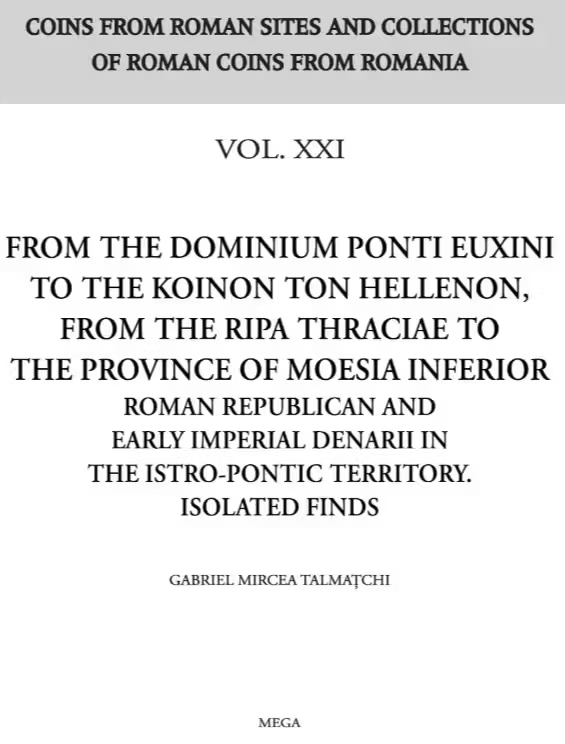
From the Dominium Ponti Euxini to the Koinon ton Hellenon, from the Ripa thraciae to the Province of Moesia inferior -Volume XXI
by Gabriel Mircea Talmatchi
- ISBN
- 9786303720739
- Publisher
- Mega
- Publication year
- 2026
- Language
- English
- Format
- Broșată
Description
From the Dominium Ponti Euxini to the Koinon ton Hellenon, from the Ripa thraciae to the Province of Moesia inferior -Volume XXI Geographically, the area in focus belongs to the Istro-Pontic region, known today as Dobrudja, a territory that, until the course of the 1st century AD, represented the northeastern extremity of the Thracian space. In fact, its west Pontic coast was integrated, starting from the 1st century BC, into the anti-Roman Pontic kingdom of Mithridates VI Eupator (120–63 BC), within a dominium Ponti Euxini. In the same area, under Roman influence, a system of alliances was formed among the western Pontic cities, reflecting a Greek community (Κοινον των Ελληνων). The growing importance of the Istro-Pontic region for the policy of Imperial Rome led to the establishment of a customs office called Ripae Thraciae, which was added to the customs district Portorium Illyrici Utriusque, attested under Claudius, but very possibly created as early as Augustus or even earlier.Strabo, referring to the Istro-Pontic territory and part of the Thracian land, speaks of Little Scythia (μικρα Σκυθια/ Mikra Skythia), viewed as an extension of the Scythian lands located north of the Black Sea (beyond the Tyras and Istrus, in the context of the Scythians’ settlement “in the nearby land”). This name has no connection to the later Roman province of Scythia, which would encompass the Istro-Pontic territory during the 4th–7th centuries AD.Chronologically, the period addressed in this work covers approximately 280 years of the evolution of the Dobrujan region, representing a relatively narrow temporal unit. Its conclusion coincides with a phase marked by numerous military events occurring in the Lower Danube area, within an environment rife with insecurity, such as those that took place during the reign of Emperor Domitianus. A consequence of these circumstances is the numerous hoards of coins hidden during this time, including those identified in the Istro-Pontic territory. This upper limit, considered as the chronological boundary, can be accepted if it is assumed that the hoards containing Republican and early Imperial coins discovered were assembled or buried by this date.
Categories
Prices at stores
No offers available for this book.
Related books
Carti care au schimbat istoria
in 3 stores
Stefan cel Mare si Sfant
in 1 store

Constantin Stere. In preajma revolutiei (set 2 vol.)
in 1 store
Istoria nespusa a romilor din Romania
Ioan Valentin Negoi
in 2 stores

Incredibila istorie: Minunile lumii
Gabriel Tudor
in 2 stores
Alexandru cel Mare si elenismul
Oana Barbu
in 2 stores